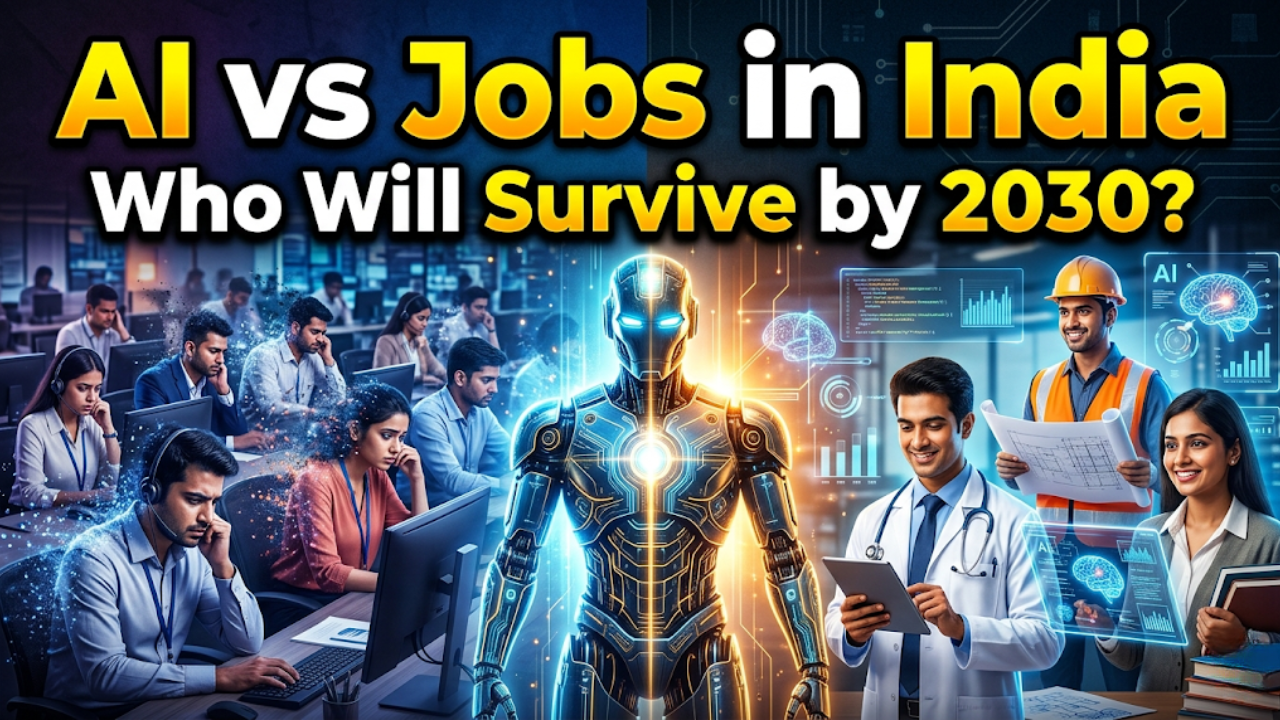
India is in the crosshairs of the most sweeping technological shift since the IT revolution of the 1990s. Generative AI, robotic process automation, and large language models are no longer science fiction — they are running in Indian banks, BPOs, hospitals, and law firms right now.
But here’s the uncomfortable truth most career advice misses: AI doesn’t eliminate professions. It eliminates tasks within professions. And the difference between a professional whose job disappears and one who thrives depends entirely on which skills they hold.
This deep-dive breaks down — skill by skill — which jobs will be safe from AI in India, which are at serious risk, and how you can position yourself on the right side of this transformation.
Why India’s AI Job Risk Is Uniquely High — And Uniquely Nuanced
Before analyzing specific roles, it’s critical to understand the Indian context.
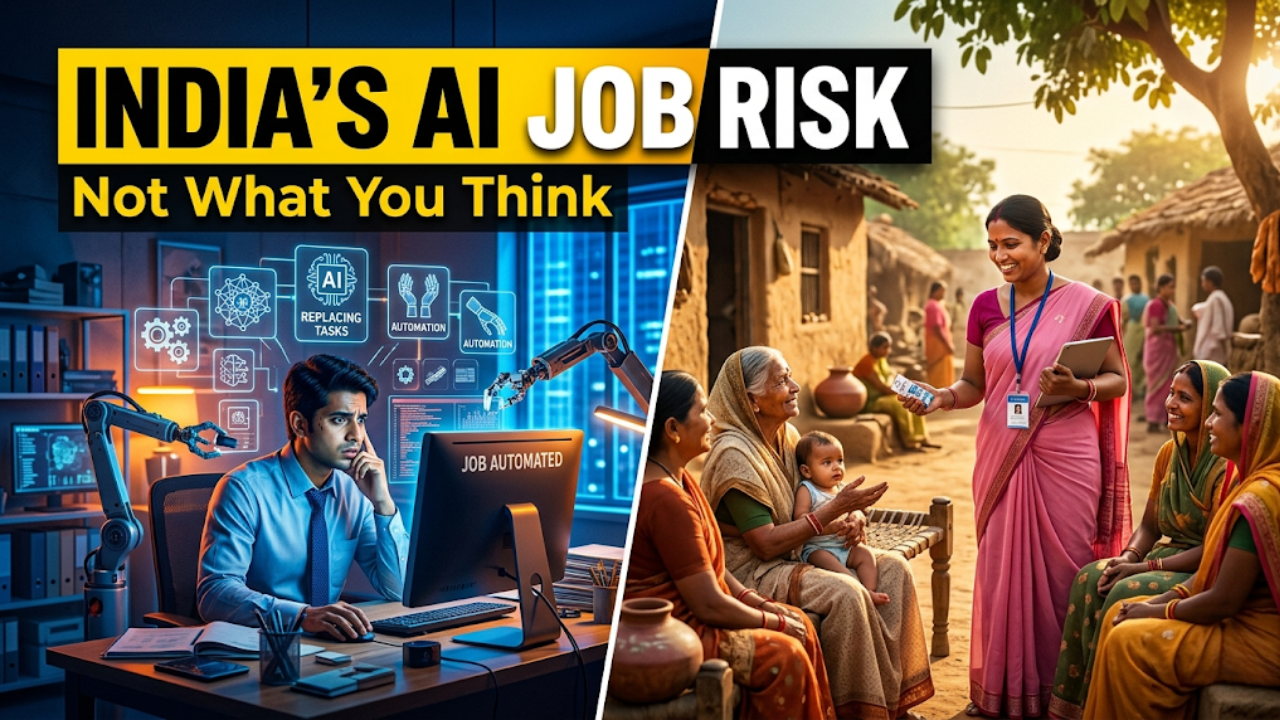
India has one of the world’s largest pools of English-speaking, college-educated workers employed in rule-based, process-driven roles — exactly the category AI automates fastest. Back-office BPO, data entry, basic software testing, and paralegal research are all deeply embedded in the Indian economy.
At the same time, India’s massive informal economy, infrastructure gaps, and cultural complexity create a huge category of work that AI genuinely cannot touch for decades. A rural health worker navigating family dynamics, caste sensitivities, and local dialect is doing something no language model can replicate.
The question, therefore, isn’t just “is my industry safe?” — it’s “are my specific skills safe?”
The Core Framework: What AI Can and Cannot Do
To analyze jobs skill by skill, we first need a clear map of AI’s actual capabilities versus its hard limits.
What AI does exceptionally well:
- Pattern recognition across large datasets
- Generating structured text, code, and summaries from templates
- Automating repetitive, rule-based decision-making
- Processing and classifying information at scale
- Translation, transcription, and basic customer query resolution
What AI cannot reliably do (yet — or perhaps ever):
- Physical dexterity in unpredictable environments
- Genuine empathy and emotional attunement
- Creative ideation driven by lived cultural experience
- Ethical judgment in ambiguous, high-stakes human situations
- Building trust-based relationships across cultural and social complexity
- Strategic leadership under conditions of radical uncertainty
With this framework, let’s examine specific professions.
Jobs That Are Safe From AI in India: A Skill-by-Skill Breakdown
1. Healthcare Professionals — High Safety (With Caveats)
Why they’re safe: Medicine in India operates in a context of extraordinary complexity — diverse languages, variable infrastructure, social determinants of health that require human judgment, and a doctor-patient relationship built on deep cultural trust. AI can assist in diagnosis (radiology AI is already here), but it cannot replace the clinical gestalt — the integration of subtle physical cues, patient history, emotional state, and contextual knowledge that a skilled physician brings.
Specific skills that are AI-proof:
- Surgical dexterity (robotic surgery assists, not replaces)
- Emergency triage under resource constraints
- Complex case management across comorbidities
- Palliative care and patient counseling
- Community health worker roles in rural India
At-risk tasks within healthcare: Medical transcription, basic diagnostic image flagging, appointment scheduling, insurance claim processing — these are already being automated.
Bottom line for job seekers: Medical, nursing, and allied health professions remain among the most AI-resistant careers in India. The risk is in administrative healthcare tasks, not clinical care.
2. Skilled Trades and Infrastructure Work — Very High Safety
Plumbers, electricians, civil engineers on-site, HVAC technicians, construction supervisors — these are jobs that require physical navigation of unpredictable real-world environments. India’s massive infrastructure buildout under initiatives like PM Gati Shakti ensures explosive demand for these skills through at least 2035.
The key AI-proof skill here is physical adaptability. A robot can weld in a controlled factory setting. It cannot rewire a 40-year-old apartment in a Mumbai chawl while negotiating with a suspicious landlord.
Specific AI-proof skills in trades:
- Site-specific problem-solving
- Equipment calibration and fault diagnosis in variable conditions
- Client-facing project management
- Safety supervision requiring contextual human judgment
Career opportunity signal: ITI-trained tradespeople in India are chronically undersupplied. AI increases this gap by drawing educated workers toward tech — making skilled trades more valuable, not less.
3. Teachers and Educators — Moderate to High Safety (Role Is Transforming)
AI tutoring tools are impressive. Khan Academy’s AI tutor, tools like Khanmigo, and India-specific EdTech platforms are getting better every year. Does this mean teachers are redundant? Absolutely not — but their role is shifting.
What AI replaces in education:
- Rote content delivery
- Basic quiz and assessment generation
- Personalized drill practice at scale
What AI cannot replace:
- Mentorship and motivational relationships
- Recognizing when a child’s academic struggle is rooted in a family crisis
- Classroom culture-building and group dynamics management
- Teaching creative thinking and ethical reasoning
- Navigating the socioeconomic complexity of Indian classrooms
The AI-proof educator profile: Teachers who use AI as a tool for personalization while doubling down on mentorship, emotional intelligence, and higher-order thinking facilitation will thrive. Those who only deliver content from a textbook face genuine disruption.
4. Legal Professionals — Bifurcated Risk
India has approximately 1.7 million lawyers — and AI is coming for a significant portion of the billable hours they currently command.
High-risk legal tasks (already being automated):
- Contract review and due diligence
- Legal research and case citation finding
- Drafting standard agreements (NDAs, employment contracts, MoUs)
- Document discovery in litigation
Low-risk legal skills:
- Courtroom advocacy requiring rhetorical skill and live adaptation
- Client counseling in emotionally charged situations (divorce, criminal defense)
- Complex negotiation across parties with competing interests
- Regulatory strategy and lobbying
- High-stakes M&A and transactional judgment calls
The verdict: Junior lawyers doing document review are at high risk. Senior advocates, litigators, and specialized counsel (IP, constitutional law, cross-border taxation) are comparatively safe — provided they adopt AI tools to amplify their output.
5. Mental Health Professionals — Very High Safety
India faces a staggering mental health crisis with fewer than 0.75 psychiatrists per 100,000 people. This gap is not being filled by AI chatbots — and ethically, it shouldn’t be.
Therapy requires attunement, the ability to sense what is not being said, cultural competency (the way depression presents in a Bihari man navigating family shame is different from how it appears in a Bangalore startup founder), and the trust built over months of consistent human relationship.
AI can perform mental health screening and psychoeducation delivery. It cannot provide therapy. This is one of the clearest cases of a profession that becomes more valuable as AI proliferates — because AI-induced job anxiety, social isolation, and identity disruption will increase demand for human mental health support.
6. Creative Professionals — The Most Nuanced Case
This is where the analysis becomes most contested. Generative AI (Midjourney, Sora, Claude, ChatGPT) is genuinely threatening certain creative tasks. Yet it’s creating new opportunities simultaneously.
Creative skills at serious risk:
- Stock illustration and generic graphic design
- Boilerplate copywriting and product description writing
- Basic video editing and background music composition
- Entry-level content creation without a distinctive voice
Creative skills that are AI-proof (or AI-amplified):
- Original conceptual thinking — the idea behind a campaign
- Brand storytelling rooted in deep cultural insight
- Art direction requiring aesthetic judgment and client relationship management
- Comedy, satire, and cultural commentary requiring lived Indian experience
- Performance arts (theater, music, dance)
- Documentary filmmaking requiring human trust-building
The creative professional’s survival rule: Stop selling execution. Start selling perspective. AI can execute; it cannot have a genuine point of view rooted in human experience.
7. Agricultural and Food Systems Workers — Moderate Safety, Evolving
India’s agricultural sector employs over 40% of the workforce. AI is transforming farming (precision agriculture, crop disease detection via drones, soil analysis) — but it is doing so as an augmentation tool, not a replacement.
Safe agricultural skills:
- Agricultural extension work (farmer education and community liaison)
- Specialized organic and niche crop cultivation
- Agri-entrepreneurship and supply chain management
- Food processing quality control requiring sensory judgment
The risk in agriculture is more about economic viability than AI automation per se — but workers who adopt AgriTech tools will outcompete those who don’t.
8. Government and Public Administration — Protected but Disrupted
India’s government employs over 17 million people. These jobs are structurally protected by policy, unions, and the sheer institutional weight of the Indian state. However, internal disruption is real — AI is being deployed in document processing, tax assessment, and citizen service delivery.
Safe government skills: Policy design, legislative drafting, inter-departmental coordination, public grievance resolution requiring human accountability, and diplomatic and law enforcement roles.
At-risk government tasks: Data entry, routine file processing, basic citizen query resolution — all being digitized and automated through initiatives like DigiLocker and UMANG.
The Skills Framework: What to Build Right Now
Across every sector, the following skills consistently appear as AI-resistant across the Indian economy:
1. Complex Communication and Negotiation The ability to navigate disagreement, read unspoken dynamics, and build consensus across diverse stakeholders. AI can draft a proposal; it cannot run a room.
2. Ethical Judgment in High-Stakes Contexts Decisions where being wrong has serious human consequences — in medicine, law, finance, and governance — will remain human-led because accountability must remain human.
3. Cross-Cultural Emotional Intelligence India’s extraordinary diversity means that navigating cultural nuance is a professional skill of immense value. No AI trained predominantly on Western internet data fully grasps the complexity of caste, regional identity, religious sensibility, and generational dynamics in Indian professional contexts.
4. Physical World Expertise Any work requiring fine motor skills, spatial adaptation, and real-time physical problem-solving in variable environments remains highly resistant to automation.
5. Creative Synthesis and Original Ideation Not content creation — idea creation. The ability to connect disparate concepts in ways that are surprising and culturally resonant.
6. AI Tool Mastery Critically, one of the safest skill sets is the ability to deploy AI effectively. Prompt engineering, AI workflow design, and human-AI collaboration management are emerging as India’s hottest skill categories.
Jobs at High Risk in India: Be Honest With Yourself
These roles face serious disruption by 2030. If you’re in one, it doesn’t mean you’re finished — it means you need to act now.
- Data entry and document processing operators — Already being replaced at scale
- Basic call center agents (non-complex query resolution) — AI handles 60–70% of tier-1 queries already
- Routine software testing professionals — AI-assisted testing is transforming QA
- Basic paralegal and legal research associates — LLMs are faster and cheaper at case research
- Stock content creators (generic blogs, boilerplate social media) — AI writes faster at lower cost
- Bank branch tellers (routine transactions) — Digital banking and AI have already decimated this role
Frequently Asked Questions
Q: Will AI take over jobs in India faster than in Western countries?
India is exposed in specific ways — its large BPO sector and process-driven white-collar work are highly automatable. However, India’s informal economy, infrastructure gaps, language diversity, and cost dynamics mean full automation timelines are longer than in the US or Europe for many sectors. The net impact depends heavily on the specific industry.
Q: Which degree is most future-proof in India right now?
Degrees that combine domain expertise with digital and AI literacy are the most future-proof. A doctor who understands AI-assisted diagnostics, a lawyer who uses AI for research amplification, or an engineer specializing in AI systems integration — these hybrid profiles are in exceptional demand. Purely technical AI/ML degrees are valuable but face their own saturation risk.
Q: Is the IT sector in India safe from AI?
Partially. India’s IT sector is undergoing rapid transformation. AI is automating a significant portion of routine coding, testing, and maintenance work. However, architects, AI/ML engineers, cybersecurity specialists, and those who manage complex client relationships remain highly valued. The sector overall will likely shrink in headcount while growing in revenue — fewer people doing more complex work.
Q: Can upskilling really protect me from AI disruption?
Yes — with an important caveat. The right upskilling (toward the AI-resistant skills listed above) meaningfully improves your resilience. Generic upskilling (adding another certification in a commoditizing skill) does not. The question to ask is: does this skill make me better at something AI fundamentally cannot do?
Q: Which Indian cities will be most affected by AI job disruption?
Bangalore, Hyderabad, Pune, and Chennai — India’s major IT and BPO hubs — face the most concentrated disruption because of their high density of process-driven tech roles. Tier-2 cities with more diverse economic bases may see slower disruption but fewer opportunities as well. Rural India’s informal economy is largely insulated from AI in the near term.
Q: What about government jobs — are they really AI-proof?
Government positions offer structural job security that private sector roles do not. However, internal workflows are being automated rapidly, and future hiring may shrink as efficiency gains reduce headcount needs. The jobs that exist today in government are relatively safe; future volume of government hiring may decrease.
The Bottom Line: AI Doesn’t Replace People. It Replaces Tasks.
The most dangerous career mistake an Indian professional can make right now is thinking about AI in terms of jobs rather than skills. Your job title doesn’t protect you. Your skills do.
The workers who will thrive through this transformation share a common profile: they are domain experts who have deliberately developed skills in AI-resistant areas (empathy, judgment, physical expertise, cultural intelligence) and they are fluent enough with AI tools to amplify their output dramatically.
India has navigated technological disruption before — and emerged stronger. The IT revolution of the 1990s didn’t destroy Indian workers; it created an entirely new professional class. The AI revolution of the 2020s will do the same — for those who choose to adapt rather than wait.